QuStream Platform
The first practical implementation of Operational Perfect Secrecy (OPS) for data-plane confidentiality.
Beyond Computational Hardness
Most quantum-safe products protect the key exchange layer , the handshake before data flows. QuStream protects the data plane itself, using Operational Perfect Secrecy (OPS) to extend information-theoretic security (ITS) into every byte of traffic.
OPS is a formal generalisation of Shannon's 1949 perfect secrecy theorem. It bounds adversarial success probability to ≤ 2−t, independent of computing power, classical or quantum. Unlike PQC, whose security rests on computational hardness assumptions, OPS provides unconditional confidentiality.
Position in the Network Stack
Key exchange layer
PQC (ML-KEM) operates here
Q-Stream overlay layer
QuStream operates here: OPS encryption
Application layer
Standard protocols unchanged
QuStream deploys as a transparent overlay. It intercepts traffic at the data plane, applies OTP-based encryption using MEKs derived locally from authenticated public Q-Block epochs and a secret DFK ratchet, then passes traffic downstream. Integration is non-disruptive to existing TLS, AES, or QKD infrastructure.
How it Works
The machinery behind Practical Information-Theoretic Security.
Q-Blocks
Authenticated public quantum-noise epochs generated by QRNGs. They are distributed over existing networks and contain no recipient markers, key pointers, or embedded keys.
DFKs
Local secret ratchet states held by endpoints. Each DFK selects extraction paths through a public Q-Block epoch, derives a one-time MEK, then refreshes itself to the next DFK state.
MEKs
Message-Encryption Keys derived by F(DFK_t, Q_t, ctx_t). Each MEK is used exactly once for XOR encryption, preserving strict Shannon-grade non-reuse semantics.
Master-Nodes
Part of the trusted computing base. They generate Q-Blocks from QRNGs and maintain the minimal synchronization state required for device onboarding and session recovery.
Proxy-Nodes
Relay nodes that operate within your enterprise perimeter. They hold no cryptographic state and cannot observe or derive MEKs from the traffic they relay. They provide transport-layer scalability without increasing the trust boundary.
Ecosystem Compatibility
Complementary to PQC
PQC (ML-KEM, ML-DSA) handles authentication and key negotiation. QuStream handles confidentiality. Running both provides defence in depth: PQC for identity verification, OPS for unconditional data-plane secrecy.
Solves QKD's Last-Mile
QKD secures node-to-node links, but end-device delivery often reintroduces computational assumptions. QuStream can use quantum-origin noise epochs as a public substrate while endpoints derive traffic keys locally from their DFK ratchets, avoiding key transmission over the network.
Data Plane vs Control Plane
By decoupling security logic from the data flow, QuStream achieves line-rate performance unreachable by computational algorithms.
Data Plane: Pure combinational XOR. Structural latency floor: ~4–6 ns at 100 Gbit/s.
Control Plane: Handles Q-Block epoch sequencing, synchronization, authentication, and replay protection on a separate channel.
Deployment Advantage
- No rip-and-replace of legacy kits
- Lightweight sidecar C++ integration
- Transport-independent (IP, Fibre, Sat)
- SNDL-immune architecture
QuVault Wallet
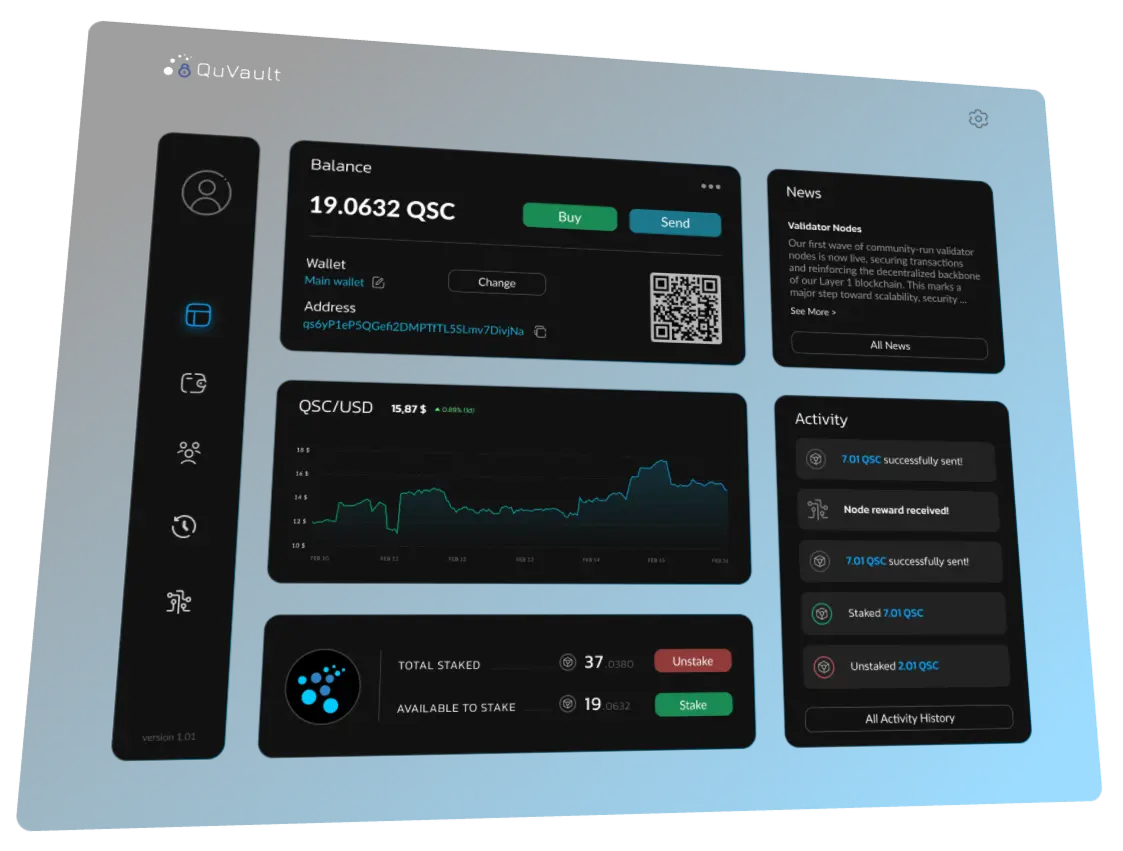
QuVault will be a next-generation, quantum-safe crypto wallet, secured with the QuStream encryption algorithm to provide unmatched protection against future cyber threats. Available as a desktop app and Chrome extension, QuVault will combine top-tier security with seamless usability.
With QuVault, users will be able to send, receive, exchange, and buy cryptocurrencies securely while benefiting from quantum-resistant encryption. It will allow users to stake and unstake tokens, track their validator node status and rewards, and manage their portfolio across multiple blockchains.
Seamless Web3 Integration
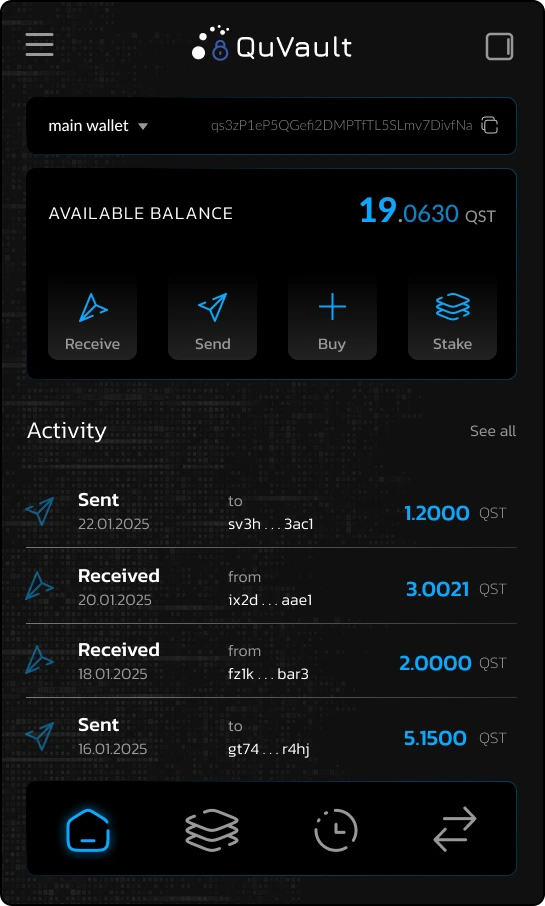
The QuVault Chrome Extension will bring seamless and quantum-safe crypto management directly to your browser. Designed for fast transactions and effortless Web3 integration, it will allow users to send, receive, exchange, and stake tokens with just a few clicks.
With real-time validator monitoring, on-chain governance voting, and multi-chain support, QuVault will provide a powerful yet lightweight experience for managing digital assets. Secured with the QuStream encryption algorithm, it will ensure your keys and transactions remain protected against future quantum threats.
Stay in control while interacting with dApps, DeFi platforms, and blockchain networks - all from a secure, easy-to-use browser extension.
Request Technical Briefing
Explore how Operational Perfect Secrecy fits into your existing network architecture. Download the implementation guide and review our reference architecture.